Blog
 Categories
 - Blue Sapphire (Neelam)
- Yellow Sapphire (Pukhraj)
- Emerald (Panna)
- Ruby (Manik)
- Diamond (Heera)
- Pearl (Moti)
- Cat's Eye (Lehsunia)
- Hessonite (Gomed)
- Coral (Moonga)
- Amethyst
- Opal
- Alexandrite
- festive
- Sapphires
- Ammolite
- Larimar Stone
- Turquoise Stone (Firoza)
- Tourmalines
- Moonstones
- Lapis Lazuli
- Zodiac Birthstone
- Citrine
- Tanzanite
- Gemstone
- Trending
- Color Gemstone
How To Tell If Pearls Are Real Or Fake?
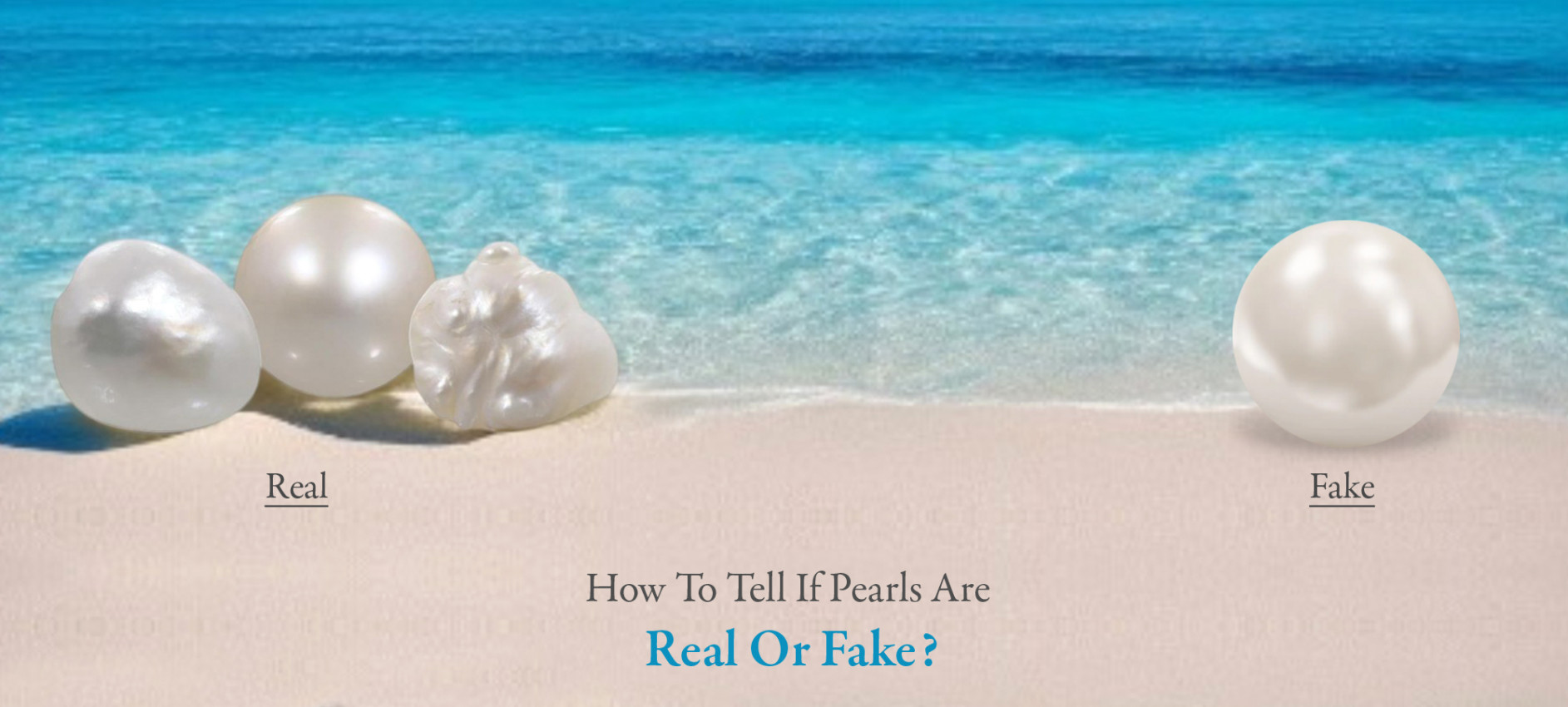
Pearls have long been associated with purity, glamour, and beauty. However, in the modern market where malpractice methods are advanced than ever before, it is often challenging to tell the difference between the real and fake pearls.
What then are the indicators that the pearls you are ogling are the real ones? If you shop online or examine a heirloom jewel, and dont know how to tell whether pearls are genuine or clever imitations, then retailers, and the pearl stone experts, are here to guide you through what to look at and sense with your fingertips to make the wise choice.
Let's discuss in brief how to check if your pearls are real or not.
What is a Real Pearl?
The genuine ones are made within the molluscs (which are found in water bodies) - either organically, or by the hand of man. It has two forms:
Natural pearls: They are formed without any human intervention; they are very scarce, and they are scarcely to be found in the market today.
Cultured pearls: These are developed by putting an irritant into a mollusc so as to induce the formation of a pearl in labs. Such ones are widely used and are not as valuable and expensive as the real ones.
They both are composed of nacre, a crystal material that makes the pearls look lustrous and multi-toned. Artificial ones, however, are often manufactured out of glass, plastic or resin under a protective coating in an attempt to mimic the nacre look.
Also Read - How Are Pearls Formed? The Birth of Moti Gems


Visual Clues: What To See
1. Surface Texture
Pearls almost never come perfect. They often have ridges, bumps, or irregularities as they are made organically. The surface of fake pearls is glass-like and looks too good.
2. Luster
Real pearls look like they were lighted (in a subtle layered effect, nearly a three-dimensional light) on all of their edges. An imitation pearl can shine, but light does not have depth in it.
3. Color Variations
Subtle overtones or color variations are characteristic of real pearls.
Read More - Why Pearl Jewelry Is the Secret Beauty Weapon of Every Woman .
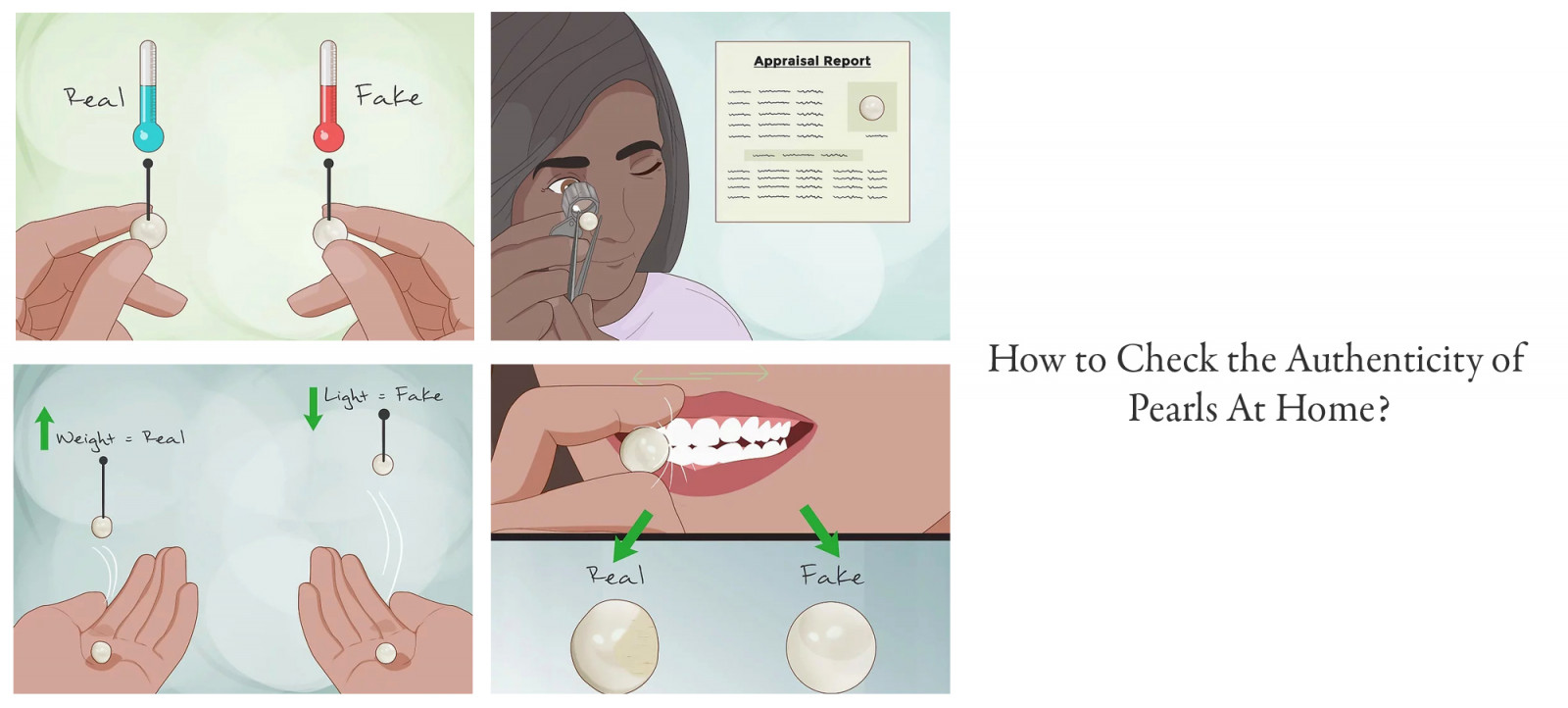
How to Check the Authenticity of Pearls At Home?
Here are some tests that you can do at home to see if the pearls you have are real:
1. Tooth Test
Rub the pearl on the front teeth edge with tenderness. The real pearls feel abrasive as a result of the nacre layers. Fake pearls are smooth or glassy to the touch.
2. Weight Test
Real pearls are of higher density and weight as compared to the plastic imitations. Make them rattle around in your hand - weight naturally - real ones will feel heavier, while the fake ones will be much lighter in weight.
3. Temperature Test
Real pearls feel cool, and they warm up slowly after being worn on the skin. Especially plastic products, fake pearls feel warm to the touch at once.
4. Glass Magnifying Test
Under magnification, real pearls have a few flaws that you can see. Fake pearls are all rounded smoothly.
Further Reading - Are Pearls Worth Buying as an Investment?
Licensed Verification Techniques
And if you are not sure, a jeweller or a gemologist can conduct complicated tests:
- Microscopic Examination: Under the microscope, nacre has a structural crystalline arrangement that can be seen. Experts can check and tell.
- Refractometer Test: Measures the peculiar refraction of light of organic pearls.
- UV Light Test: Real pearls tend to have a very faint fluorescence; fake ones tend not to have that at all.
Best Way to Tell If Your Pearl is Real!
The best way to make sure that your pearls (also known as Moti Stone ) are to buy from a reputable seller who provides lab certification from a renowned lab, which proves the authenticity of the gem.
The gemstone lab certification will have all the details of the gem, including its origin, colour, grade, etc.
Know More - Is it OK to Wear Pearls Every Day?
Pearl Simulants in History
Made-up pearls are not an ingenious idea. Manufacture of chemical-based faux pearls can be traced to as early as 83 CE, which was practised by Chinese artisans. Iridescent beads were made of wax filled by Venetian glassmakers in the 16th century. In the 18th century, fish-scale essence was used to coat "Roman Pearls" as a simulant.
Among simulants existing today, there is:
- pearlescent-coated glass beads.
- Artificial pearls, made of plastic.
- Imitations of mother-of-pearl or shell-based.
- The hematites and blister pearls were used to imitate black pearl stone.
In Conclusion
Pearls are not mere pieces of ornaments; they become sentimental outlays. No one wants a fake.
Hence, Navratan brings you authentic and original gemstones only, all lab-certified from well-known laboratories. In our part of the business, we believe in transparency and trust. All the pearls we sell have been certified, ethically obtained and are backed by professional gemological testing. The thing
is that as far as timeless beauty is concerned, only the original will suffice. Visit us now at Navratan.com.


- Blue Sapphire (Neelam)
- Yellow Sapphire (Pukhraj)
- Emerald (Panna)
- Ruby (Manik)
- Diamond (Heera)
- Pearl (Moti)
- Cat's Eye (Lehsunia)
- Hessonite (Gomed)
- Coral (Moonga)
- Amethyst
- Opal
- Alexandrite
- festive
- Sapphires
- Ammolite
- Larimar Stone
- Turquoise Stone (Firoza)
- Tourmalines
- Moonstones
- Lapis Lazuli
- Zodiac Birthstone
- Citrine
- Tanzanite
- Gemstone
- Trending
- Color Gemstone


-
 May 7th, 2026
 -
 March 10th, 2026
 -
Timeless Jewelry Essentials: 5 Investment Pieces Everyone Needs
March 7th, 2026 -
 March 5th, 2026
 -